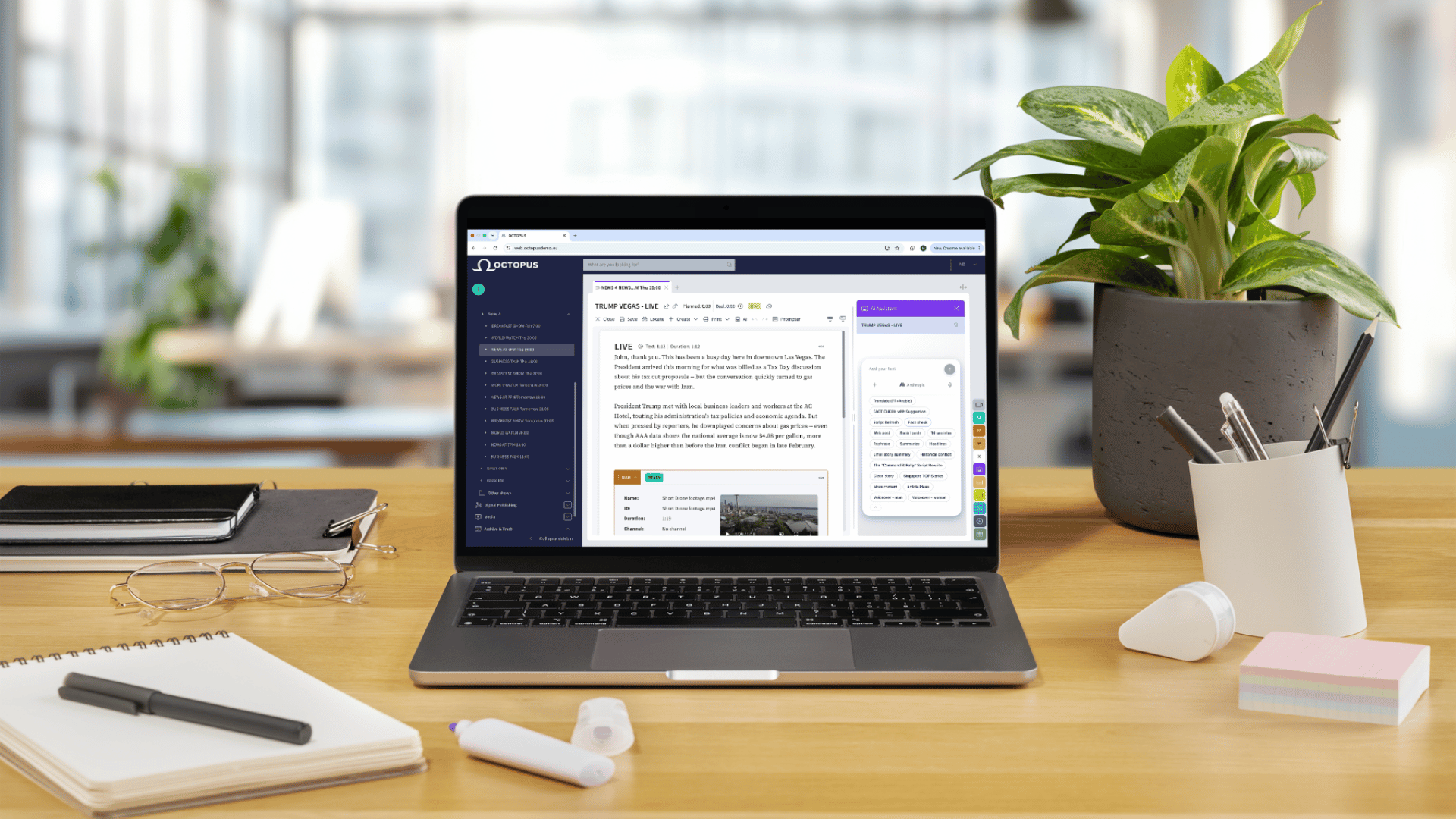
By noon, one story has to be a live TV segment, a web article, a vertical clip for social, and a line in the radio bulletin. The reporting was done once. The packaging gets done four or five times, by hand, across systems that were never built to talk to each other. That is the hidden cost most newsrooms absorb on every story, every day. Story-centric news production is the approach built to eliminate that cost.
What is story-centric news production?
Story-centric news production is an approach to broadcast news in which the story, not the rundown row, is the core unit of work. A journalist plans, writes, and publishes one story across TV, web, social, radio, and mobile from a single workflow, instead of rebuilding it separately for each platform.
In practical terms, a story-centric system lets journalists plan, create, and publish across platforms in one workflow. The story evolves from idea, to rundown, to social post without duplication or delay. There is no switching between systems, and no need to decide which platform comes first. The focus stays where it belongs: on accurate, compelling journalism. The story comes first, always.
“In today’s fast-moving media world, journalists face greater demands than ever: the race to break news, the need to deliver across TV, web, social, and mobile, and the pressure to engage audiences everywhere, all while navigating a sea of complex tools and workflows. But what if technology didn’t get in the way? What if it freed journalists to do what they do best: tell great stories? At Octopus Newsroom, we believe the future belongs to story-centric newsrooms, where content, not technology, is the anchor of everything”
Gabriel Janko, COO, Octopus Newsroom

Story-centric vs rundown-centric workflow
Both approaches are valid. The difference is what a journalist’s day is organised around. A rundown-centric workflow puts running-order discipline first, which suits tightly timed linear shows. A story-centric workflow puts the story first, which suits operations where one story has to reach several audiences.
Dimension Rundown-centric workflow Story-centric workflow Core unit of work The rundown row, a slot in a linear running order The story, independent of where it airs or publishes Where work starts Build the running order, then fill each slot Plan the story, then decide its outputs Multi-platform output Each platform is often a separate task in a separate tool One story becomes many outputs from a single source When the story changes Update the row; other outputs are updated by hand Update the story; connected outputs share its state Best suited to Tightly timed linear shows where running-order discipline is the priority Multi-platform operations where one story must reach several audiences
Story-centric vs rundown-based NRCS
The workflow difference above comes from how the newsroom computer system (NRCS) is built. A rundown-centric workflow is the traditional pairing with a rundown-based NRCS, a system organised around the running order of a broadcast. A story-centric workflow is enabled by a story-centric NRCS, a system organised around the story as a standalone editorial item, with the rundown row treated as one of its outputs. The two pairs of terms describe the same distinction at two levels: how a team works, and how the system underneath is built.
| Dimension | Rundown-based NRCS | Story-centric NRCS |
| Organised around | The running order of a broadcast | The story as a standalone editorial item |
| A rundown row is | The primary object | One of several outputs of a story |
| Digital and social outputs | Often produced as separate steps | Produced from the same story record |
| Editorial content and automation logic | Often held in separate, bespoke templates | Can live in one object (story templates) |
Can one system do both story-centric and rundown?
Yes. In Octopus, story-centric or rundown-centric is a choice teams make, not a mode the system forces on everyone. Two teams can work two different ways inside one system: a digital desk can work story-first, while a linear news team keeps the running-order discipline it depends on for high-stakes live production.
That choice is the point. A national broadcaster running a 6pm bulletin does not want to abandon rundown rigor, and it does not have to. A story-centric team publishing across web and social does not want to be forced into a linear artifact, and it is not. The trade-off worth naming up front: story-centric working asks a team to think about a story’s outputs earlier than a rundown-only habit does. Octopus lets each team decide which model fits, rather than imposing one on the whole newsroom.
Benefits of a story-centric workflow
- One story, many outputs. A single story can become a TV segment, a web article, a radio item, and a social post from one workflow (multi-platform output covers TV, webTV, radio, social, sports, eSports).
- Less duplicated work. The reporting is done once; packaging for each platform draws on the same source rather than being re-created in a separate tool.
- One source of record. The story, its outputs, and its history share a state and an audit trail, so it is clear what changed and where.
- Editorial and automation in one place. Story templates hold editorial content and automation logic together in a single object, rather than in disconnected templates.
- Change the process without waiting on IT. The No-Code Workflow Designer lets a newsroom adjust approvals, publishing paths, notifications, and task assignments without developer work.
- Keep linear discipline when you need it. Rundown-centric mode stays available, per team, so nothing is lost for the shows that depend on it.
Latest Octopus features for story-centric newsrooms
A story-centric approach only helps if the system keeps up when the story changes. Three recent Octopus capabilities are built for exactly that moment.
Element skipping
When a story breaks mid-show, the running order has to change without breaking the broadcast. Element Skipping lets producers skip primary or secondary rundown elements without disrupting the rest of the show. Built for fast-moving news, it helps teams react to breaking developments, timing changes, or last-minute editorial decisions in seconds. The rundown adjusts automatically while preserving workflow continuity, reducing manual intervention, and lowering the risk of on-air errors, so broadcasts keep running even when plans change at the last moment.
Contextual AI
AI is only useful in a newsroom if it works from what the newsroom already knows. Contextual AI is context-aware assistance that respects editorial intent, enhancing scripts with relevant information and helping journalists work faster without changing their voice. Rather than generic prompting, Octopus uses what is already in your rundown, your wires, and your active assignments to shape its responses. The result: summaries that reflect your newsroom’s angle, headlines tailored to your actual coverage, and suggestions that stay on topic. Every AI output stays visible, editable, and rejectable. AI assists judgement; it never replaces it.
No-code workflow designer
Editorial processes change faster than IT can rebuild them. The No-Code Workflow Designer lets teams build and adapt newsroom workflows without relying on developers or custom integrations. Using a drag-and-drop interface, teams can create, modify, and automate processes, from content approvals and publishing paths to notifications, task assignments, and automated actions, all tailored to how a given newsroom works. It makes it easier to remove bottlenecks and adjust as editorial processes change.
Story-centric newsroom examples
RTL Deutschland / ntv: story-template-driven news production
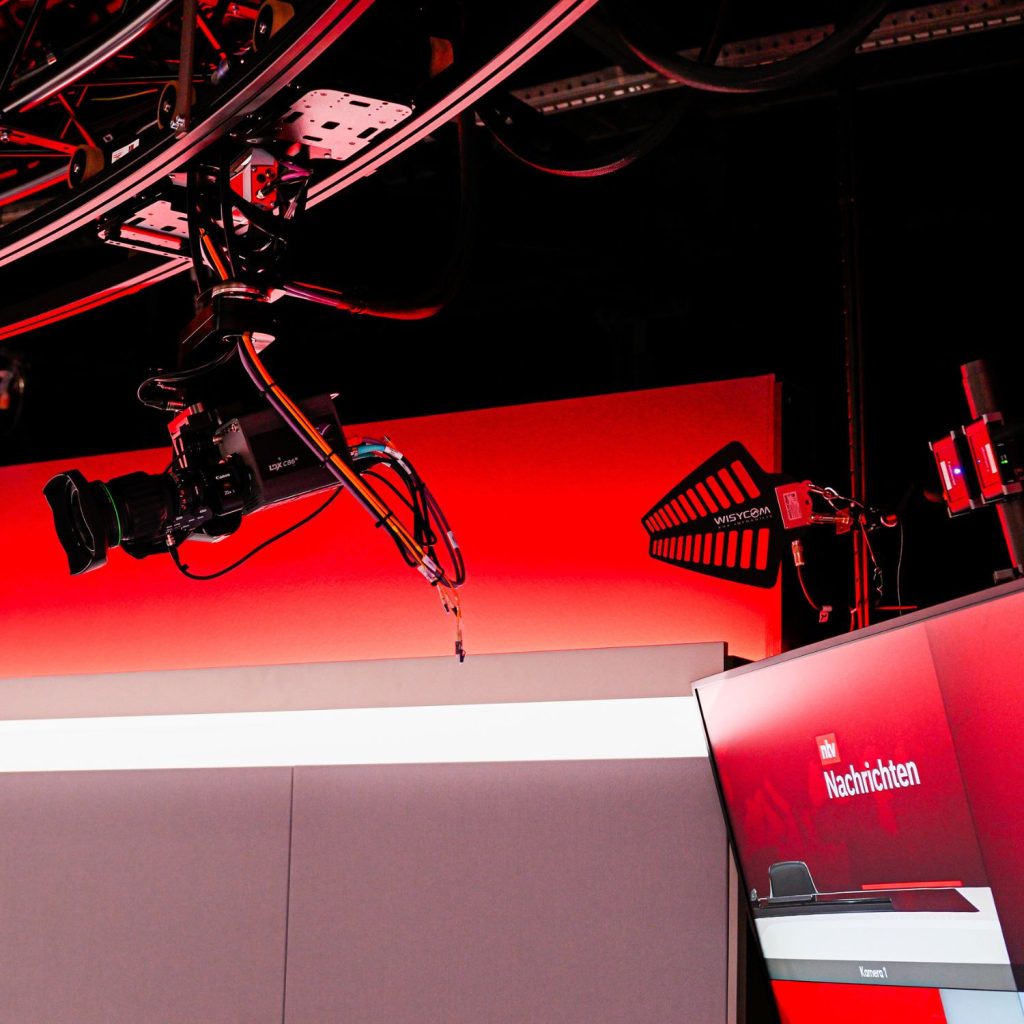
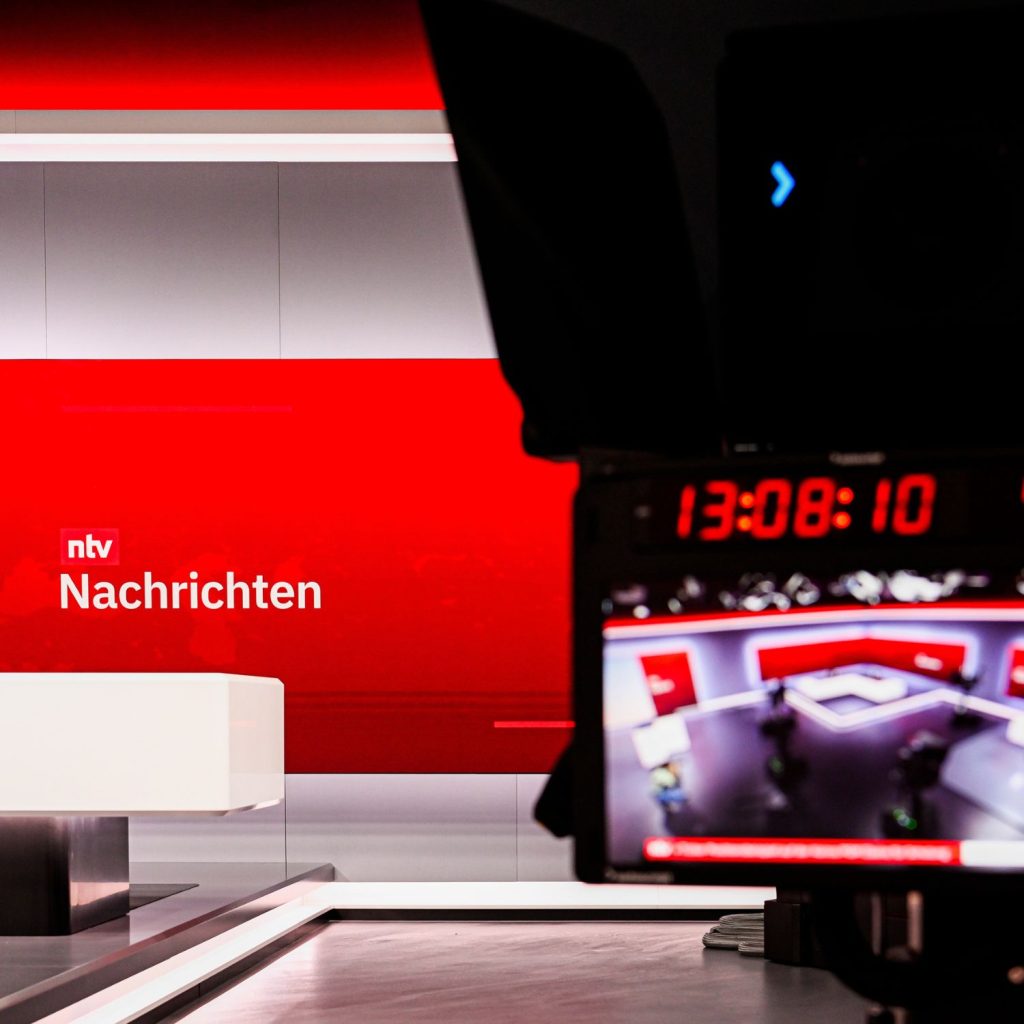
As part of a newsroom modernization that replaced its legacy NC Power system across the national channel ntv and its regional operations, RTL Deutschland reworked how editorial and studio automation work together at national scale. Rather than porting years of highly customised studio-automation (Mosart) templates onto a new platform, Octopus delivered a unified platform built on story-template-driven workflows, embedding automation, graphics, and production intelligence directly into the story instead of holding them in separate, bespoke templates. ntv went live on Octopus in May 2026, with Deutschland am Morgen, a new morning show from ntv and RTL, following days later; core software and servers are hosted in Cologne, the implementation was carried out in partnership with LOGIC Media Solutions, and the regional rollout is continuing.
This is the clearest public illustration that story-centric is a mechanism, not a slogan. Production intelligence lives in the story itself rather than in separate systems, which is what story-template-driven means in practice.
MTV Oy
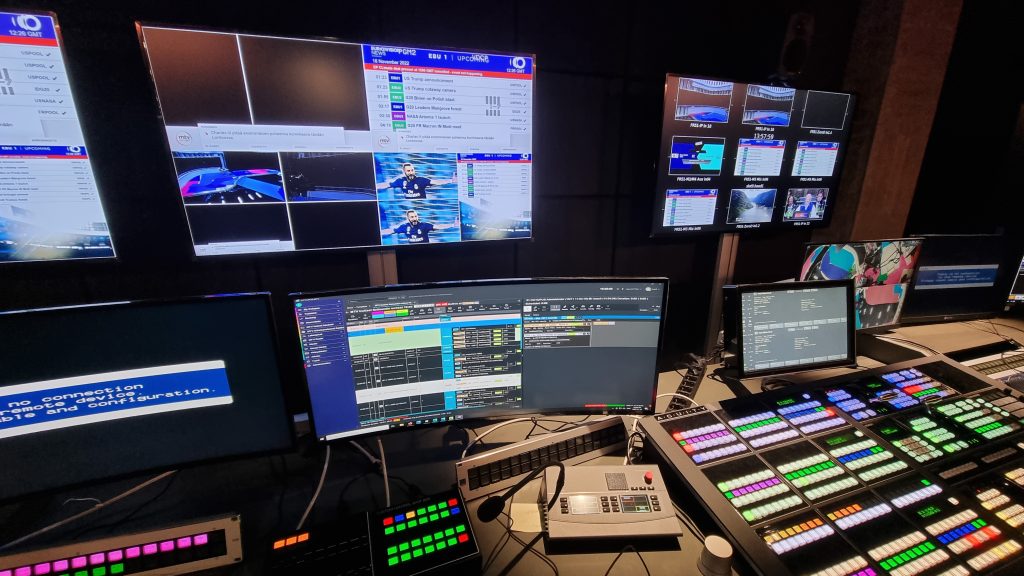
MTV Oy, described as Finland’s leading commercial television company and video content house, moved to a new facility and modernised its production, selecting Octopus among the vendors for the transition. As published on octopus-news.com, one system handles live news, radio, digital, and non-linear channels together, integrated with EVS (IPD-VIA) for asset management and Adobe Premiere Pro for editing, with NEP Finland as main integrator. It is an example of one story reaching several outputs from one system. Public detail on measured outcomes is limited, so this is best used as a multi-output example rather than a full outcome case.
Frequently asked questions
What is story-centric news production? It is an approach to broadcast news in which the story, not the rundown row, is the core unit of work. One story is planned once and published across TV, web, social, radio, and mobile from a single workflow.
What is the difference between story-centric and rundown-centric? A rundown-centric workflow is organised around the running order of a broadcast, with each platform typically produced as a separate step. A story-centric workflow is organised around the story, so one story becomes many outputs from a single source.
Can one newsroom system do both story-centric and rundown-centric? Yes. In Octopus, teams choose story-centric or rundown-centric per team, and both work inside one system.
Is story-centric better than rundown-centric? Neither is universally better. Rundown-centric working suits tightly timed linear shows; story-centric working suits multi-platform operations. Octopus lets each team choose the model that fits its work.
What is an example of a story-centric newsroom? RTL Deutschland rebuilt its studio-automation workflow on Octopus story templates so editorial content and automation logic live in one object.
Curious to learn more? Get in touch.