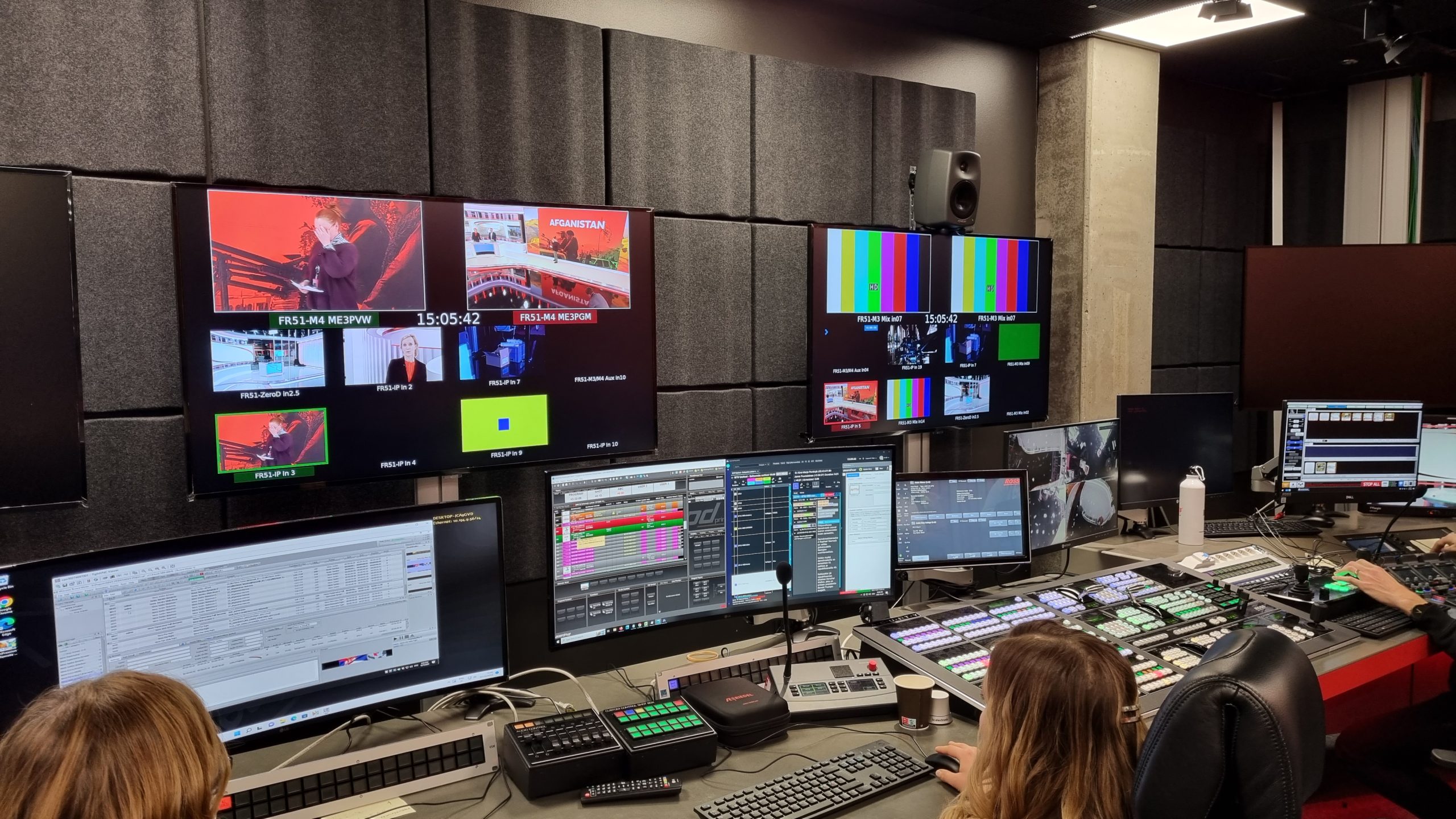
A broadcast newsroom is the editorial team and production system that turns raw information – wires, field reports, interviews, video – into scheduled and breaking news for television and radio, and increasingly for web, apps and social media at the same time. Behind every bulletin is a chain of planning, writing, editing and approvals that has to run on deadline, every day. This guide explains who works in a broadcast newsroom, how the desks are organised, how a story travels from idea to air, and which technology holds it all together.
Who works in a broadcast newsroom?
Team size varies from a handful of people at a regional station to hundreds at a national broadcaster, but the core roles are similar:
Role | What they do |
|---|---|
| News director / editor-in-chief | Sets editorial priorities and standards; owns the final call on what airs |
| Planning or assignment desk | Tracks upcoming events, assigns reporters and crews, monitors wires |
| Producers | Build and time the rundown for each show; decide running order |
| Reporters and journalists | Gather facts, record interviews, file scripts and packages from the field |
| Writers and editors | Write and check scripts, headlines and on-screen text |
| Video editors and graphics operators | Cut packages and prepare on-air graphics |
| Director and studio crew | Run the live show: cameras, playout, graphics, prompter |
| Presenters and anchors | Read the news on air from the prompter |
| Digital producers | Adapt stories for web, app and social channels |
How is a broadcast newsroom laid out?
Most newsrooms are organised around a central hub – often called the news desk – where planning, producing and editing teams sit close together so decisions move fast. Specialist desks (sport, politics, regional, digital) sit around that hub, with edit suites and the control room nearby.
The physical newsroom layout matters less than it used to. Journalists now file from the field, producers work from home, and teams in different cities share one rundown. The “layout” that counts is increasingly the digital one: who can see which story, at what stage, from where.
How does a story get from idea to air?
- Plan. The planning desk logs the story idea, assigns a reporter and links relevant wires and research.
- Gather. The reporter collects facts, video and interviews, often filing directly from the field on a mobile device.
- Write. Scripts, on-screen text and graphics requests are written and attached to the story.
- Review. Editors check accuracy and tone; changes stay visible to the whole team.
- Build the rundown. Producers place the story in a show’s running order and time each segment.
- Go to air. The control room plays the rundown out live, with graphics, video and prompter text pulled from the same story.
- Publish everywhere. The same story is adapted for web, app, radio and social, then archived for reuse.
When breaking news hits, steps collapse into minutes. Producers drop, reorder or replace items in a live rundown, which is why the underlying workflow has to be flexible.
What technology does a broadcast newsroom use?
A modern newsroom technology stack usually includes:
- A newsroom computer system (NRCS) – the editorial core where stories are planned, written, approved and placed into rundowns.
- Graphics systems for lower thirds, maps and full-screen visuals.
- Media asset management (MAM) for storing and finding video.
- Playout and studio automation to run the show on air.
- Prompters that display scripts to presenters.
- Wire services and feeds from news agencies.
- Web CMS and social tools for digital publishing.
- AI tools for transcription, translation, summaries and drafting.
These systems talk to each other through the MOS protocol (Media Object Server), an industry standard that lets an NRCS exchange rundowns and media objects with graphics, video and playout devices, plus open APIs for everything else.
What is a newsroom computer system (NRCS)?
An NRCS is the software at the centre of a broadcast newsroom. It connects planning, writing and rundown production in one place and passes the right content to every device and platform in the chain. Without it, a newsroom runs on spreadsheets, email and shared folders – and loses time at every handoff.
Traditional NRCS platforms were built around the rundown, the linear running order of a TV or radio show. Modern newsrooms publish to many outputs at once, so many now work story-centric: the story is the core unit, and each output – a TV package, a radio read, a web article, a social post – is a version of it.
How Octopus supports broadcast newsrooms
400+ newsrooms and 18,000+ daily users already trust Octopus Newsroom to power their work with a feature-rich, all-in-one newsroom management solution:
- Story-centric or rundown-centric. Teams choose the workflow that fits them; the system does not impose one.
- One story, many outputs. TV, webTV, radio, sports, eSports and social from a single story.
- Deploy your way. On-premise, cloud or hybrid — and you can change your mind later.
- Integrated with 100+ tools you already own via MOS and open APIs: graphics, MAM, playout, automation, AI engines, social and CMS.
- Embedded AI you control. Choose your model, run local models on your own infrastructure, and keep every AI output visible, traceable, editable and rejectable. Octopus MCP connects the newsroom to the AI tools your organisation already uses.
- No-Code Workflow Designer. Change editorial processes without developer involvement.
Want to see how it fits your newsroom? Book a demo.
FAQ
What is the difference between a broadcast newsroom and a digital newsroom?
A broadcast newsroom produces scheduled and live programmes for TV and radio, while a digital newsroom publishes continuously to web, apps and social. Most broadcasters now run both from one team and one system.
What software do broadcast newsrooms use?
Broadcast newsrooms run on a newsroom computer system (NRCS) connected to graphics, media asset management, playout, prompter, wire and web publishing tools, usually via the MOS protocol and open APIs.
What does NRCS stand for?
NRCS stands for newsroom computer system – the software where broadcast stories are planned, written, approved and placed into rundowns.
What is a rundown in TV news?
A rundown is the running order of a news show: every story, segment and break, with its timing, in the order it will air.
What is the MOS protocol?
MOS (Media Object Server) is an industry standard that lets a newsroom computer system exchange rundowns and media with graphics, video and playout systems.
Can a broadcast newsroom use AI without sending content to the cloud?
Yes, if its newsroom system supports local models. Octopus can run AI models on the newsroom’s own infrastructure, so editorial content stays inside its environment.
Is story-centric better than rundown-centric?
Neither is better for every team: story-centric suits multi-platform publishing, rundown-centric suits tightly timed linear shows. Octopus lets teams use either.