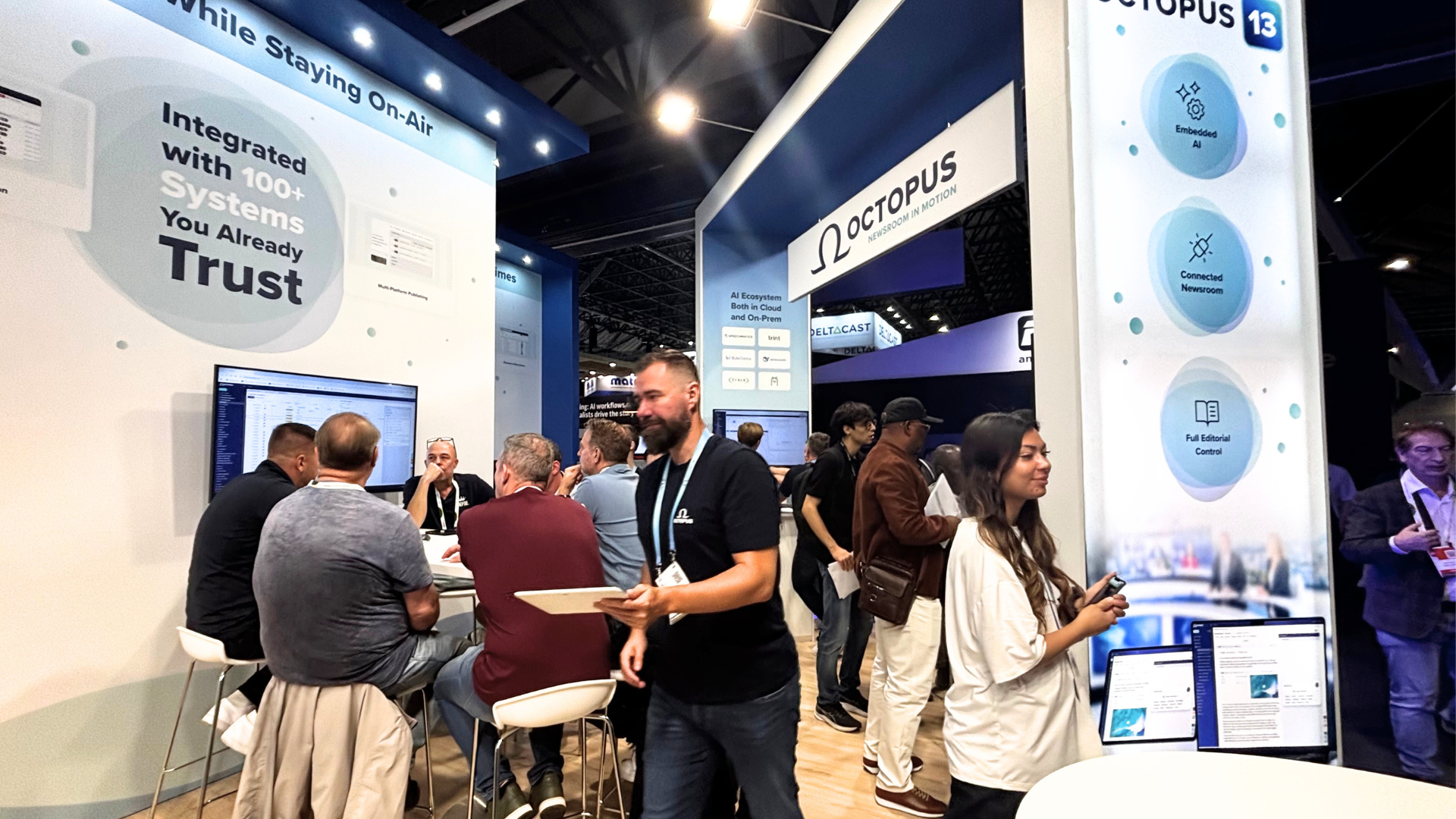
Four days of demos, conversations and new ideas in Amsterdam – and one thing became clear: the next generation newsroom isn’t somewhere in the future. It’s already taking shape.
IBC 2026 is behind us, but the conversations that started in Amsterdam are very much still moving. At Booth 6.C12, we introduced Octopus 13 – the next generation of Octopus NRC – and explored what the future of news production can look like when AI, editorial context, connected systems, and flexible workflows come together.
Across demos, customer conversations, partner meetings and our Customer Exchange sessions, one question kept coming back: How can newsrooms move forward with AI and new technology without losing control of the workflows that already work?
That question shaped much of what we showed at IBC.
Octopus 13 Takes Center Stage
IBC marked the official introduction of Octopus 13, bringing together the technologies we believe will define the next generation of newsroom production. At its core is the same principle Octopus has always been built around: technology should support journalists and newsroom teams – not force them to work around the technology.
But the environment around them is changing fast. Newsrooms are producing for more platforms, connecting more systems, and exploring new ways to use AI. At the same time, they need to modernize without disrupting everyday production.
That’s where Octopus 13 comes in.
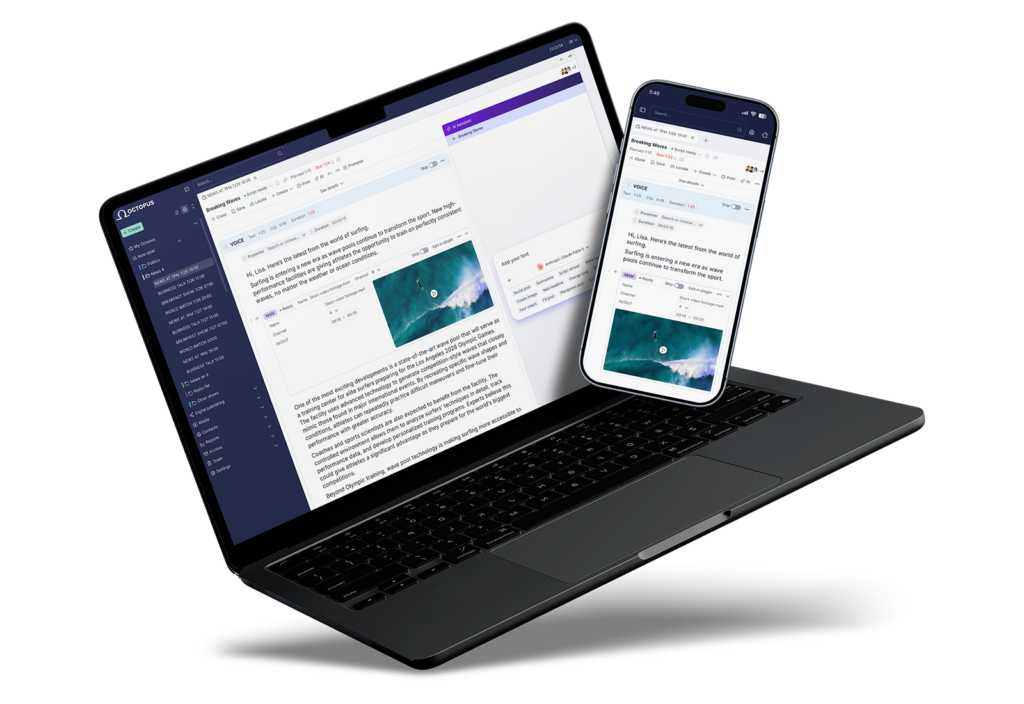
From story-centric workflows and multi-platform publishing to more than 100 integrations, flexible deployment, and AI assistance, Octopus 13 brings those capabilities into one connected newsroom environment. And at IBC, one area generated particularly interesting conversations.
From Generative AI to Agentic AI
AI was hardly a new topic at IBC. What is changing is the conversation around what AI can actually do inside a newsroom. Generative AI can create, summarize, or transform content. Agentic AI goes further by understanding context, accessing information, and interacting with the systems around it.
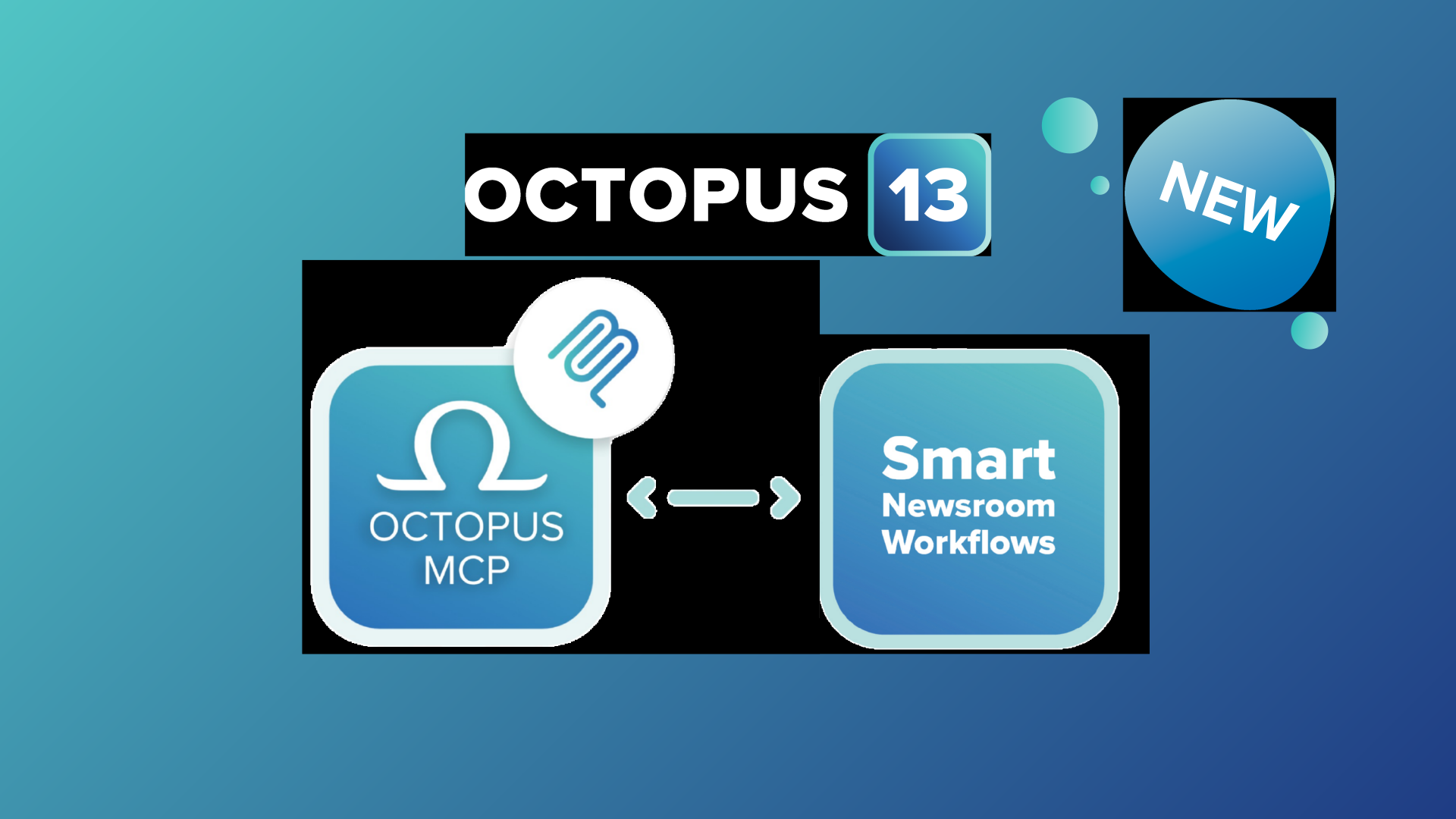
That’s what we demonstrated with Octopus 13 and the Octopus Model Context Protocol (MCP). Instead of treating AI as another standalone tool journalists have to open and prompt separately, MCP gives AI agents a structured way to access newsroom information and work within the editorial environment. That opens the door to very different workflows.
An AI agent can help find relevant stories and archive material, support research, work with newsroom context, or assist with tasks around a developing story – while the journalist remains in control. The important part isn’t simply that AI can do more. It’s that AI can finally better understand where it is working.
Context Changes Everything
One of the deeper discussions at IBC about AI was about context. A newsroom story isn’t just a block of text. It comes with metadata, sources, assignments, relationships, production information, versions, and editorial decisions. For AI to become genuinely useful in professional news production, it needs a reliable way to understand that environment.
That’s why we’re also working on an open standard for story context – exploring how structured newsroom information can move between systems and give AI a richer, more accurate understanding of the story it is supporting.
The goal isn’t to create another closed ecosystem. It’s the opposite. By combining an open approach to story context with MCP, Octopus 13 is designed to connect newsroom workflows with a growing AI ecosystem, including external tools such as Microsoft Copilot and Perplexity AI – while allowing broadcasters to decide where AI runs, what it can access, and how it is used.
AI should adapt to the newsroom. The newsroom shouldn’t have to adapt to AI.
Connected Production Still Matters
AI may have dominated many conversations at IBC, but another message came through just as strongly: Newsrooms still need their systems to work together. Editorial, automation, graphics, control room systems, digital publishing and collaboration tools are increasingly interconnected. A powerful feature in isolation doesn’t solve much if it creates another disconnected step in the production chain.
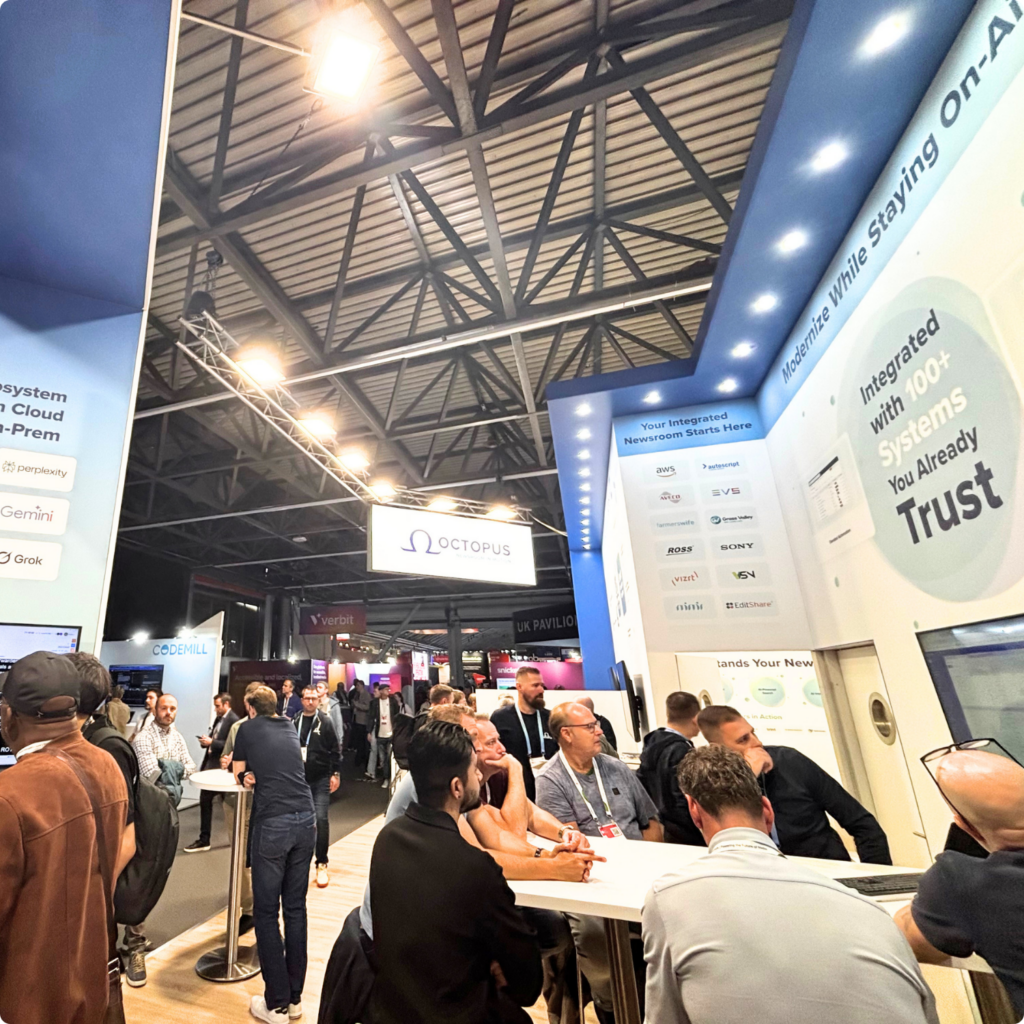
That’s why connectivity remains central to Octopus 13. With 100+ technology integrations, story-centric production, and automated workflows, Octopus connects the systems surrounding the newsroom while keeping the story at the center.
At IBC, we demonstrated how editorial decisions can flow through production and publishing without teams repeatedly moving information between systems or rebuilding workflows around individual technologies. Because the next generation newsroom isn’t about adding more technology. It’s about making the technology already there work better together.


Flexibility Beyond the Newsroom
Where journalism happens has changed, too. Newsroom teams need to be able to collaborate, edit, approve, and publish whether they’re sitting at a desk, working from home, or reporting in the field.
At IBC, we showed how Octopus supports that flexibility through browser-based production, mobile workflows, the Octopus Journalist App, and real-time collaboration through tools including Microsoft Teams, WhatsApp, and Slack.
We also demonstrated the redesigned mobile-friendly Web Client and Mobile Prompter View, extending newsroom workflows beyond the traditional desktop environment.
And with the No-Code Workflow Designer, teams can adapt processes themselves as editorial requirements change – without every workflow adjustment becoming a development project.
Beyond the Demos
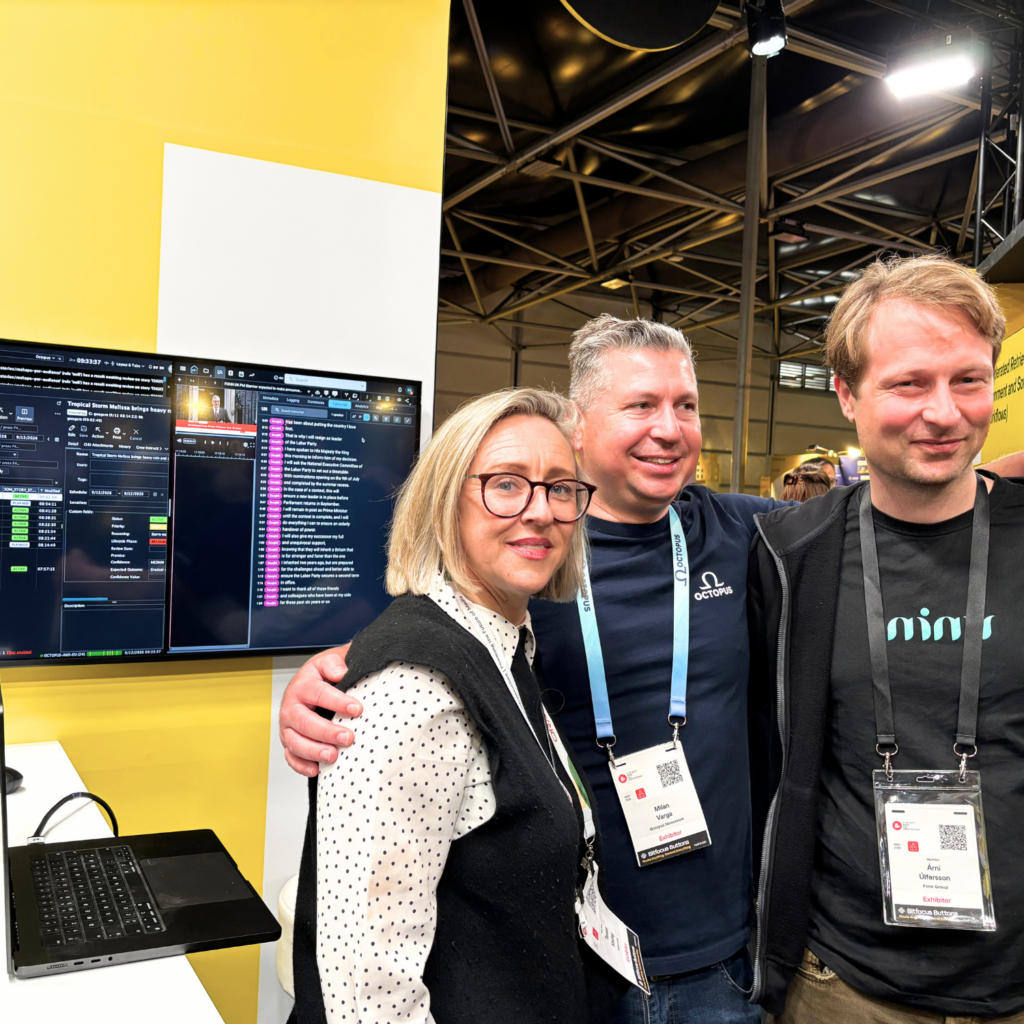
Some of the most valuable conversations at IBC happened away from the demo screens. Our Customer Exchange sessions brought customers together at the booth for open conversations about their newsroom experiences, challenges, and priorities.
We also joined discussions and presentations at the IBC Accelerator program, talked with technology partners across the show, and heard directly from broadcasters about where they see AI, automation, and newsroom technology heading next.
Different markets. Different newsroom structures. Different technology stacks. But many of the challenges were remarkably similar. How do you introduce AI responsibly? How do you modernize without disrupting production? How do you connect increasingly complex technology environments? And how do you give journalists better tools without adding more complexity to their day? Those are exactly the questions shaping what comes next for Octopus.
So, What Comes Next?
IBC 2026 may be over, but this was very much a beginning. Octopus 13 is the next step in how we see the newsroom evolving: more intelligent, more connected, and more adaptable – while keeping journalists and editorial teams firmly in control.
Over the coming weeks, we’ll be sharing more from Amsterdam, including deeper looks at MCP and agentic AI, story context, our technology partnerships and conversations with the people building and using the next generation of newsroom technology.
And if you didn’t get a chance to meet us at IBC – or want another look at what we demonstrated – the conversation doesn’t have to end in Amsterdam.
Join our upcoming Octopus Webinar – IBC 2026 Highlights and catch up!