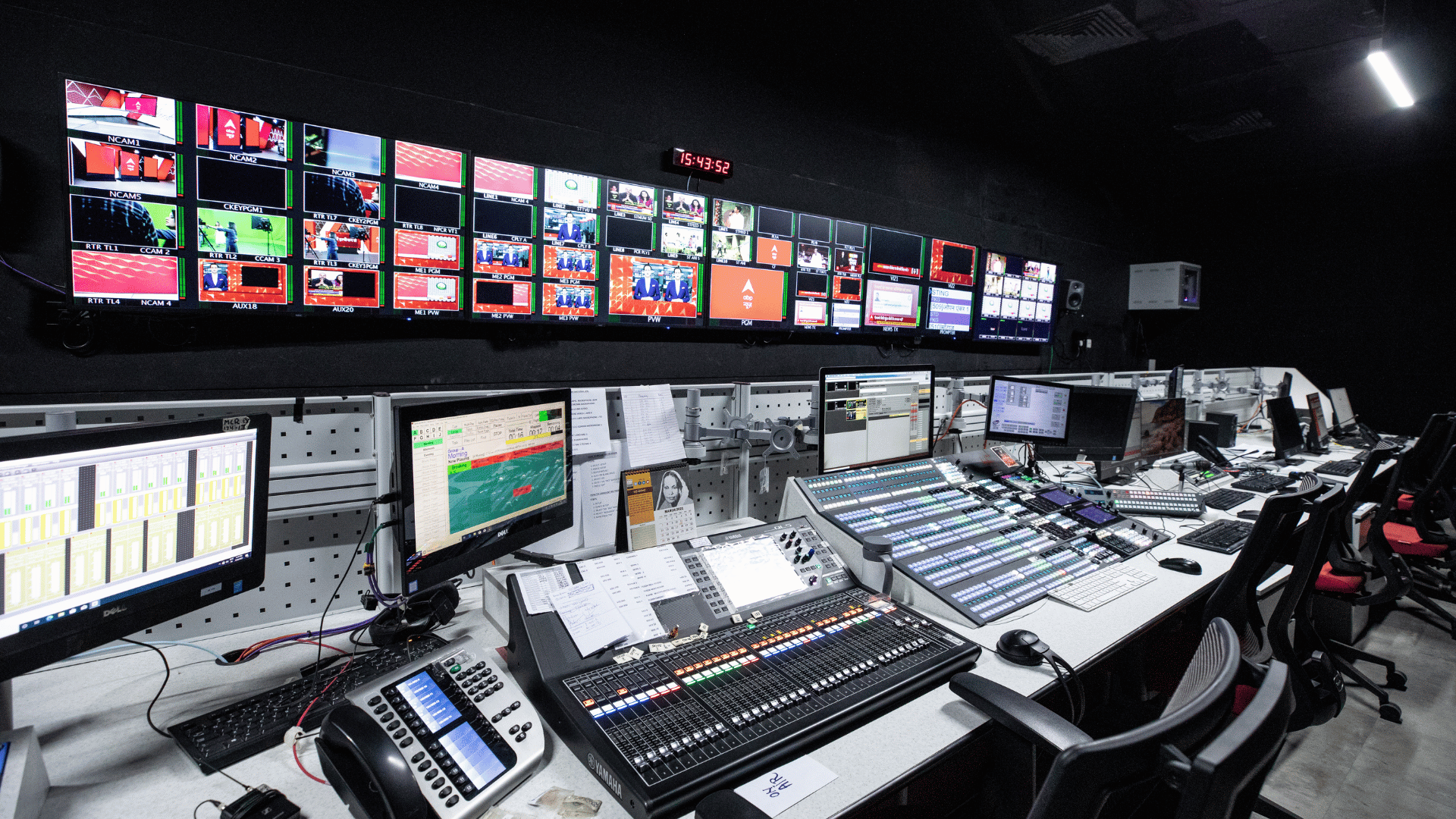
A newsroom computer system (NRCS) is the editorial software a broadcast newsroom uses to plan coverage, write and edit scripts, build and run rundowns, and publish stories across TV, web, radio, and social from a single place.
It is the system a journalist opens in the morning and closes at night: the layer that sits between news gathering and air, holding the day’s editorial work together while driving the prompters, graphics, and automation that put a show on screen. For most newsrooms the real question is no longer whether they need one, but whether the one they have can keep up with a day where a single story becomes a TV segment, an article, a vertical clip, and a social post, often within the hour.
Many newsrooms still run on systems built around the rundown, the linear running order of one broadcast, and designed before that shift to many outputs per story. That mismatch is where the daily friction lives, and it is why the category is changing.
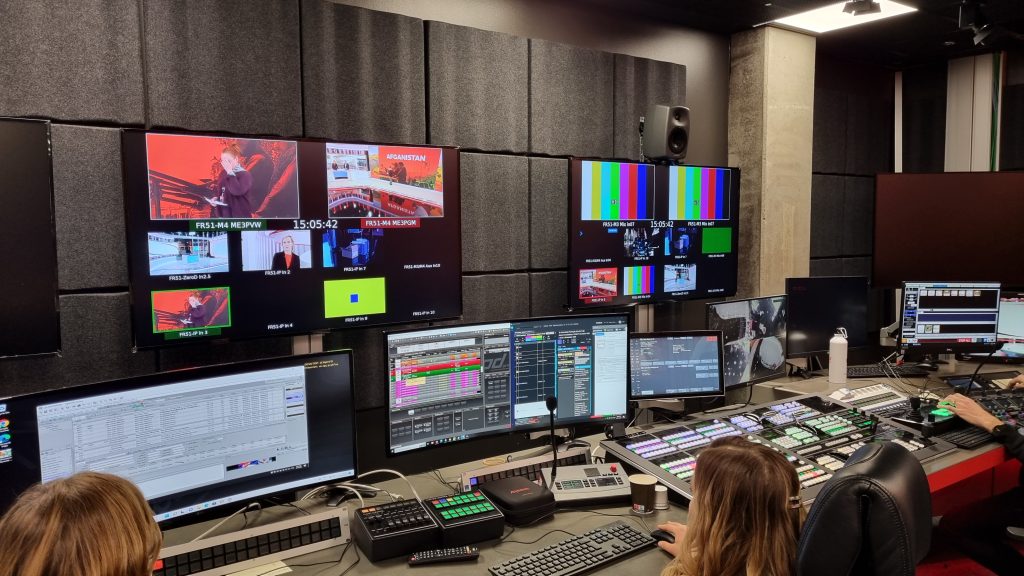

What does an NRCS do?
Across a shift, an NRCS manages the full chain from gathering to air:
- Gathering – ingesting agency wires, RSS feeds, and social monitoring into one place.
- Planning and assignment – planning coverage, assigning stories to reporters, and tracking status through the day.
- Writing and collaboration – multiple journalists writing and editing the same script at the same time.
- Rundown and timing – building, timing, and reordering the running order, and changing it live as the show develops.
- Driving connected devices – controlling prompters, graphics, playout, and studio automation over the MOS protocol.
- Publishing – sending the same story out to TV, web, radio, and social.
- Archiving and reporting – closing the loop at the end of the chain.
NRCS vs news production system: is there a difference?
The two terms are used more or less interchangeably. “Newsroom computer system” is the established category name, and the one procurement teams recognize. “News production system” is the broader phrasing some vendors prefer, because it signals that the work now runs well past the traditional bulletin. You will also see the same thing called a newsroom system, newsroom software, or newsroom workflow software. Behind all of these labels the function is the same: the editorial operating system for producing and publishing news.
What an NRCS is not
An NRCS is defined as much by its boundaries as its features. It is not your media asset management (MAM) system, your playout or studio automation, your graphics engine, or your web content management system (CMS). It connects to and drives those systems rather than replacing them.
That distinction matters when you evaluate one. A platform that claims to be all of those things at once was usually built to do one of them first, and the newsroom layer second.
You may also see systems marketed as centralized news production suites or newsroom automation tools for professional newsrooms. An NRCS overlaps with those, but it is not the same thing. It is the editorial layer that plans, writes, and runs the news, and then drives the production and automation systems around it, rather than the switcher, graphics, and automation bundle itself.
One label is worth treating with care. “Newsroom software” and “online newsroom software” are also used for public-relations and press-room tools that manage a company’s own press releases and media contacts. That is a different category from a broadcast NRCS. If you are evaluating systems, “newsroom computer system” or “news production system” is the phrasing that returns broadcast tools rather than PR ones.
How does an NRCS connect to everything else? MOS and open APIs
The mechanism is the MOS protocol (Media Object Server), the broadcast-industry standard through which an NRCS controls prompters, graphics, playout, and automation. Alongside MOS, open APIs handle the digital side: CMS, social, and custom systems. Together they are what let a newsroom system sit at the center of a stack it did not build and connect to the tools a newsroom already owns.
Octopus, for example, connects across graphics, MAM, playout, automation, AI engines, social, and CMS over MOS and open APIs.
Story-centric or rundown-centric: two ways to work
Traditionally, the atomic unit of an NRCS is the rundown row. Everything a journalist does attaches to a slot in one linear show. A story-centric system makes the story itself the atomic unit, so a rundown row, a web article, and a social post are all outputs of the same object, sharing a source, a state, and an audit trail.
Neither model is automatically right. High-stakes live news depends on rundown discipline; multi-platform desks benefit from working story-first. The practical answer for many newsrooms is a system that lets each team choose story-centric or rundown-centric, in one platform, rather than forcing the whole operation into a single model.
Cloud, on-premise, or hybrid: how an NRCS is deployed
An NRCS can run three ways: in the cloud, on-premise on hardware the newsroom owns, or in a hybrid of the two. There is no single right answer. Cloud deployment lowers hardware cost and makes remote access easier, while on-premise deployment gives the newsroom full control over a system that holds sensitive editorial data and forms a critical part of the broadcast chain. Cloud is not the free choice it can look like, either: before moving, a broadcaster should weigh network accessibility, network reliability, and total cost of ownership, and larger broadcasters tend to add trust and budget to that list. The practical takeaway is that deployment should follow the newsroom’s size, risk tolerance, and existing infrastructure rather than a vendor’s technical limit, and a system that supports all three models lets a newsroom change the choice as those needs change. To learn more, Octopus’s COO, Gabriel Janko, works through the trade-off in an interview on cloud versus on-premise news production.
Where does the AI run? Editorial content and data governance
Every NRCS vendor now advertises AI. The question that actually separates them is not whether they have it, but where your editorial content goes when you use it. For a public broadcaster, a news agency, or any newsroom under legal or political scrutiny, “which servers does my script touch, and who can see it?” is the first question a compliance officer asks, and often the hardest to get a straight answer to.
Deployment is the real differentiator. Some systems run AI only in the vendor’s cloud. Others let the newsroom choose: run local models such as Llama or DeepSeek inside your own infrastructure, connect to cloud models such as ChatGPT, Claude, Gemini, or Perplexity through a central hub, or mix the two. When a model runs locally, the editorial content is processed inside the newsroom’s own environment rather than sent to a third party. Governance features keep the final call with the journalist: every AI output stays visible, traceable, editable, and rejectable.
As Gabriel Janko, COO of Octopus Newsroom, puts it: “Newsrooms operate under pressure – editorial, legal, political – so we made it easy to keep your content protected. With local AI deployment, Octopus lets you run models directly on-premise or in your private cloud. No silent data sharing, no mystery pipelines. Your content stays where it belongs: with you. Prefer to plug into trusted tools? Choose from over 15 AI partners. Our integrations work with your compliance, not against it.”
Who uses an NRCS, and for what?
The primary users are journalists, producers, editors, and news directors, the people who plan, write, and run the show. A news producer, for instance, spends the day building and re-timing the rundown, chasing scripts and elements, and making the call when breaking news forces a change minutes before air. Engineering and IT own the integrations and the deployment topology. Compliance and procurement care about where data goes and what is logged. A good NRCS has to answer to all three.
Modernizing a legacy NRCS
Replacing a newsroom system is one of the higher-risk projects a broadcaster takes on. The newsroom cannot go dark while it happens, and years of integrations and workflows have to survive the move. That risk, not a lack of appetite, is why many newsrooms stay on end-of-life systems longer than they would like.
Octopus reduces that risk through deployment choice and phasing: cloud, on-premise, or hybrid, with the option to change the model later, and a move made in stages rather than a single hard cutover.
Where Octopus fits
Octopus is a newsroom computer system built on the idea that the editorial layer deserves its own decision. It runs story-centric or rundown-centric per team, connects to the systems a newsroom already owns over MOS and open APIs, deploys on cloud, on-premise, or hybrid, and lets a newsroom run AI on its own infrastructure or connect to the cloud models it trusts. Published figures: 400+ newsrooms and 18,000+ daily users, 25+ years in the category. Offices in Prague, New York, and Bangkok.
Frequently asked questions
Is an NRCS the same as a CMS? No. A CMS publishes and manages web content; an NRCS produces the news and can publish into a CMS. They solve different problems and usually work together.
What is the MOS protocol? MOS (Media Object Server) is the broadcast-industry standard an NRCS uses to control prompters, graphics, playout, and studio automation. It is what makes an NRCS’s connections to other broadcast devices checkable rather than proprietary.
Can one system be both story-centric and rundown-centric? Yes. Some systems let each team choose story-centric or rundown-centric within one platform, so a multi-platform desk and a high-stakes live desk can each work the way they need to.
Can an NRCS run in the cloud and on-premise? Yes. An NRCS can be deployed in the cloud, on-premise, or in a hybrid of the two, and the right choice depends on the newsroom’s size, risk tolerance, and existing infrastructure rather than a technical limit. Octopus runs all three models on the same platform, so a newsroom is not locked into one: it can start where it needs to and move between cloud, on-premise, and hybrid as those needs change.
Can AI run on-premise in a newsroom? Yes. Local models such as Llama or DeepSeek can run inside the newsroom’s own infrastructure, so editorial content is processed on hardware the newsroom controls rather than sent to a third-party cloud. Cloud models can also be connected by choice.
What are examples of NRCS platforms? The category ranges from long-established incumbents and systems bundled with production hardware, to MAM-led platforms and newer cloud-native entrants. Octopus is one of them.
What usually triggers a newsroom to replace its NRCS? Most often an end-of-support date on the current system, an AI-governance review, a move to multi-platform publishing, or licensing cost. End of support is the most common single trigger.
Curious to learn more? Get in touch.