
Artificial intelligence is rapidly becoming part of everyday newsroom workflows. From generating headlines and summaries to translating scripts and assisting with research, AI has the potential to save journalists valuable time.
But many AI tools still have one important limitation: they only know what you tell them in a prompt.
Journalists, on the other hand, rarely work with a blank page.
Every story already has context – previous coverage, related scripts, agency wires, archived footage, rundowns, interviews, production notes, planning items, and editorial decisions. Understanding these connections is often what separates a quick answer from a useful one.
That’s why we believe the future of newsroom AI isn’t just about better prompts.
It’s about better context.
AI That Understands Your Newsroom
Contextual AI goes beyond responding to a single request. Instead of treating every prompt as an isolated task, it understands the story you’re working on and the information surrounding it.
Rather than asking:
“Summarize this script.”
Imagine asking:
“Prepare me for this developing story.”
The AI already knows which story you’re editing, what has already been published, which agencies have contributed updates, which footage is linked to the story, who the key people are, and what your newsroom has covered before.
Instead of simply generating text, it becomes a newsroom assistant that works with the same editorial context as your team.

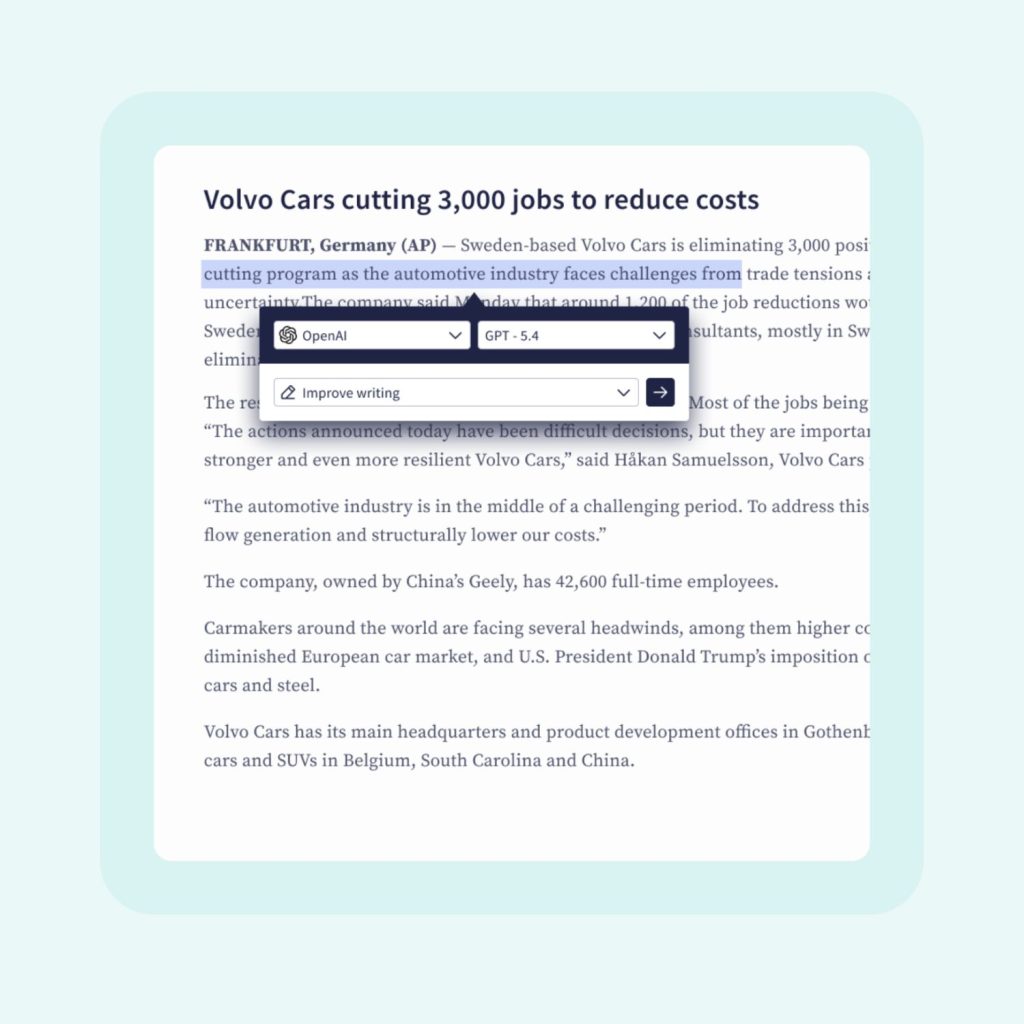
Practical Use Cases in the Newsroom
At Octopus Newsroom, we’re building AI to support real editorial workflows – not replace them. Here are just a few examples of how Contextual AI can help journalists work more efficiently.
Find Related Stories Instantly
Working on breaking news often means searching through weeks or months of previous coverage.
Contextual AI can automatically identify related stories, previous broadcasts, archived scripts, and ongoing coverage connected to the current story, giving journalists the background they need without manual searching.
Surface Relevant Production Assets
A story is much more than text.
Contextual AI can help identify associated videos, graphics, images, audio clips, and production elements linked to a story, making it easier for editorial and production teams to work from the same information.
Generate Smarter Summaries
Because the AI understands the broader story context, summaries become more accurate and meaningful. Instead of summarizing a single script in isolation, it can take into account previous developments and related content to produce richer editorial overviews.
Suggest Better Metadata
Tagging content consistently is essential for search and archiving, but it can also be time-consuming. Contextual AI can recommend relevant people, organizations, locations, topics, and keywords based on the story context, helping teams improve discoverability across the newsroom.
Support Editorial Research
Journalists often need quick background information while working against the clock.
Contextual AI can highlight previous reporting, identify recurring themes, surface related events, and provide useful context without leaving the newsroom system.
Help Teams Stay Aligned
Editorial, production, digital, and studio teams often interact with the same story from different perspectives.
When AI understands the story itself – not just an individual document – it can deliver more relevant assistance to every team involved, helping everyone stay aligned as stories evolve.
Context Creates Better AI
LLMs are incredibly capable, but their output is only as good as the information they receive.
By combining AI with newsroom data, story relationships, editorial metadata, and connected workflows, broadcasters can move beyond generic AI assistance and start benefiting from intelligence that reflects how newsrooms actually work.
The result isn’t simply faster content creation.
It’s better decision-making, stronger collaboration, and less time spent searching for information.
This Is Just the Beginning
At Octopus Newsroom, we’ve always believed technology should adapt to journalists – not the other way around.
Contextual AI is another step in that journey, helping newsrooms work smarter while keeping journalists firmly in control of the editorial process.
And it’s only the beginning.
Over the coming weeks, we’ll be sharing more about how intelligent newsroom workflows are evolving – and why understanding the story is the foundation for what’s coming next.
When AI understands your newsroom, it can do more than answer questions. It can begin to assist, coordinate, and automate routine editorial tasks. We’ll have much more to share at IBC2026.
Join us at IBC2026 to discover the next generation of newsroom technology.